
Inside GOND’s Power Shift and Nigeria’s Cultural Crossroads
Power has changed hands at the Guild of Nigerian Dancers (GOND). But does new leadership mean new answers? This isn’t just a new chapter for GOND, it could be a turning point for dance in Nigeria.

Nigeria’s dance community stands at a defining crossroads. Once again, dance finds itself caught in a familiar storm, where corporate powers mine its creativity, history fades under the glare of digital trends, and dancers struggle for recognition, protection, and fair compensation. And at the center of this pivotal moment is the Guild of Nigerian Dancers (GOND), the country’s oldest and largest dance guild. Its recent leadership shift, quietly announced on Facebook on June 26, 2025, marks more than just an internal reshuffle but It raises urgent questions about the future of Nigerian dance itself.
The new executive council, a mix of respected veterans and emerging voices, signals the possibility of change. But many within the dance community are watching with guarded hope. Because this isn’t just about who leads the Guild. It’s about whether Nigerian dance can reclaim its dignity, or slip deeper into crisis. The newly elected leaders of GOND represent both continuity and fresh perspectives. But will they drive real change, or merely inherit the same broken systems?
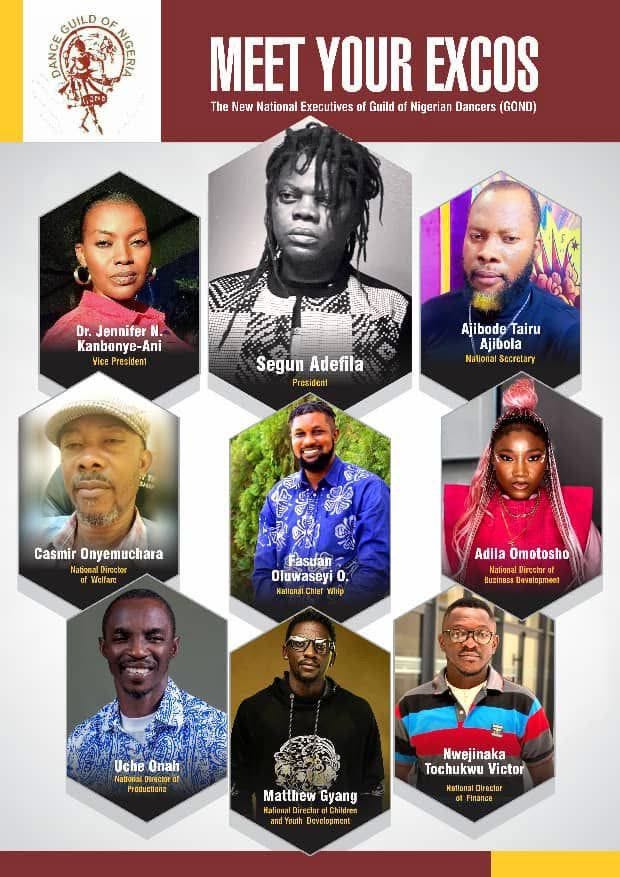
New Leaders, Familiar Questions
Segun Adefila, the National President, is widely known for his street theatre roots and for amplifying local narratives through socially engaged art. His appointment has sparked cautious optimism among some dancers, who see him as a potential disruptor.
But leading a fragmented guild is far more complex than leading a theatre troupe. Can Adefila move beyond advocacy and navigate the entrenched bureaucracy to deliver actual reforms?
Adila Omotosho, the Director of Business Development, brings youthful dynamism and versatility, with a career that spans theatre, commercial gigs, and community-based dance initiatives. Her appointment appears to signal a generational shift. Yet, without a clear policy agenda, inclusion can easily slide into symbolism. Will Omotosho push for genuine structural reform, protecting dancers’ rights even as she expands business opportunities, or simply lend GOND a youthful image?
Mathew Nyang, the National Director of Children and Youth Development, long known for championing traditional dance through youth-centered programs, now faces a deeper challenge: bridging the generational divide that has long fractured Nigeria’s dance community. His role holds immense weight, not just to preserve heritage but to foster intergenerational dialogue. Will he focus solely on traditional dance, or help dismantle the invisible walls separating Nigeria’s dance past from its future?
In addition to these three key figures, GOND’s full leadership includes six other elected executives representing diverse regions and sectors:
Jenifer N. Kanboye-Ani (National Vice President)
Ajibode Tairu Ajibola (National Secretary)
Casmir Onyemuchara (National Director of Welfare)
Fusuan Oluwaseyi .O (National Chief of Protocol)
Uche Ona (National Director of Production)
Nwejinaka Tochukwu (National Director of Finance)
Their appointments suggest a broader, more inclusive leadership. But it is Adefila, Omotosho, and Nyang whose positions place them squarely at the heart of this cultural crossroads.
Legacy and the Long Shadow of Disconnection
Founded in 1995 by pioneers like Steve James, Tony Elabor, and Hussein Shu’aibu, under its former name, the National Dance Union of Nigeria (NADUN), GOND was born from a bold vision: to unify dancers, advocate for fair labor rights, and promote dance education. For a time, it succeeded. But over the years, bureaucracy, internal conflicts, and a growing disconnect from Nigeria’s fast-changing dance scene led many dancers, especially younger, independent ones, to drift away.
In their absence, independent festivals, underground dance battles, and digital platforms flourished, creating vibrant, decentralised dance ecosystems that operate entirely outside the Guild’s reach.
Worse still, GOND’s prolonged silence during major instances of exploitation, from corporate appropriation to government neglect, deepened its image as outdated and ineffective.
Today, Nigeria’s dance sector faces urgent, material threats:
Brands using dancers’ work without fair compensation or credit.
Social media platforms profiting off viral dance trends, while creators see little or no reward.
Shrinking budgets for dance education, research, and archiving.
Growing inequality between institutional dance circles and grassroots, independent artists.
This is the reality the new GOND leadership inherits. This is their test.
The Test Ahead
The Guild’s core challenge now isn’t just administrative reform, it’s cultural survival. To remain relevant, it must evolve into a living, breathing platform that reflects the entire spectrum of Nigeria’s dance ecosystem.
This means bold action:
Restructure the Guild to include regional, genre-specific, and digital-era representatives.
Advocate for legal protections for choreographers, online creators, and touring artists.
Build transparent funding models to support both veteran and emerging dancers.
Create safe spaces for cross-generational collaboration, where both ancient rhythms and contemporary movements are equally valued.
But perhaps most critically, GOND must finally acknowledge an uncomfortable truth:
Nigeria’s dance economy isn’t failing because of a lack of passion or talent. It’s failing because of systemic exploitation, from governments, corporations, and sometimes even from within the dance community itself.
The task ahead is difficult, but necessary. Without sustained, organized advocacy from within, Nigerian dance will continue to be a cultural commodity for others to exploit.
Toward Broader Alliances?
Still, there is a window of opportunity, if GOND is ready to seize it.
In recent years, Nigeria’s Federal Ministry of Art, Culture, Tourism and the Creative Economy has deepened its partnerships with sectors like music, fashion, and film, offering them funding access, industry platforms, and global visibility.
Dancers across Nigeria are now asking:
Why not us?
As the country’s longest-standing dance body, GOND is well-positioned to advocate for similar collaborations. The question is whether it can organize itself to make such a case credible. There is cautious hope, but also growing urgency. The time for ceremonial leadership is over. What’s needed now are cultural architects, visionaries willing to dismantle old hierarchies, build new structures, and usher Nigerian dance into its rightful place within the creative economy. the dance industry.
The Stage Is Set: Will GOND Rise?
This leadership change isn’t a promise of progress, but it is a possibility. The stage is set. Dancers across Nigeria are watching, many with cautious hope, others with weary skepticism.
The question isn’t simply whether GOND will lead. It’s this: What would leadership look like if they truly did?
A utopia guild for Nigerian dancers would look like a Guild that unites, not divides, the dance community. It will be one that protects both ancient legacies and digital innovations. Also it’s one that defends dancers’ rights as fiercely as it celebrates their brilliance. The needed GOND is not just one that survives but actually leads.
That future remains within reach. The dancers are ready. The moment is here. And now, it’s GOND’s move.
 | A guest post by
|